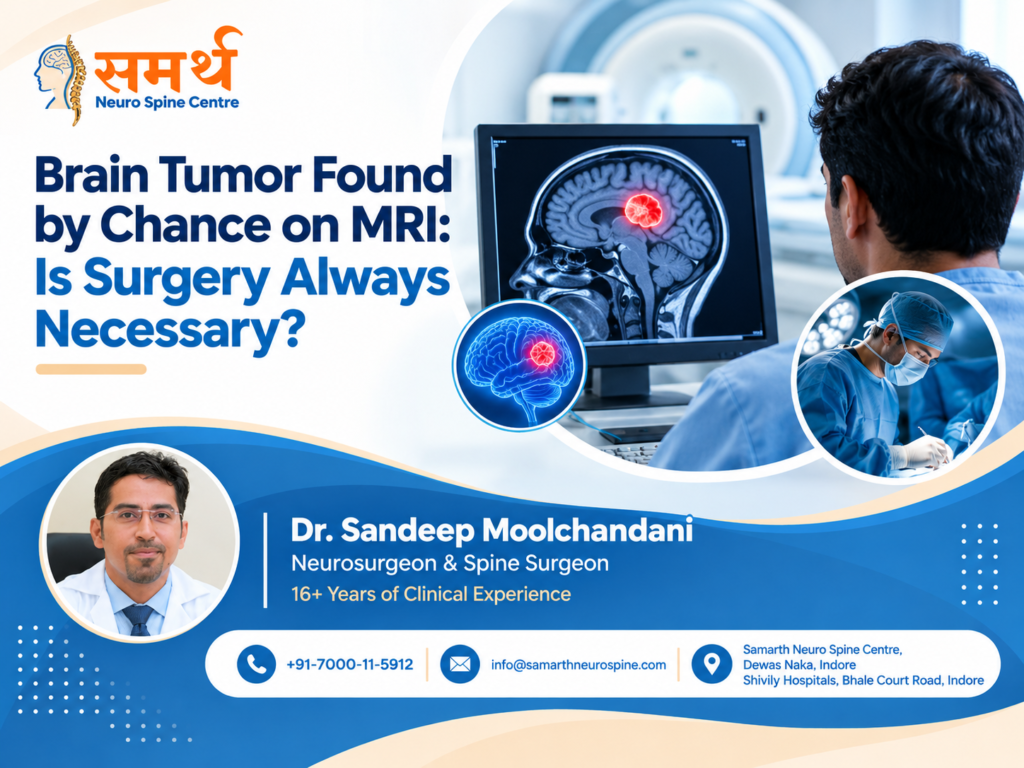
No, surgery is not always necessary for a brain tumor found by chance on MRI. Many small, slow-growing tumors, especially meningiomas, are safely watched with repeat scans, and surgery is advised only when the tumor is growing, causing symptoms, or sitting where it could cause harm. The decision depends on tumor type, size, location, growth and your overall health, not on the word “tumor” alone.
You went for a scan after a fall, a dizzy spell or a stubborn headache. Now the report says “mass”, “lesion” or “space-occupying lesion”, and your mind has already run ahead. Slow down. This guide explains what such a finding usually means, what happens next, and how doctors decide between watching and operating.
How Common Is a Chance Finding?
More common than most people think. In a well-known study of 2,000 adults with no brain symptoms who had MRI scans, about 1.6% had a benign primary brain tumor, mostly meningiomas. Many of these people never needed treatment.
That does not make every report harmless. It means the next step is a careful, specialist review, not panic and not a shrug.
What Your Report Might Actually Mean
“Tumor” is a wide word. On a chance MRI, the finding is often one of these:
- Meningioma: a slow-growing tumor on the brain’s lining, usually benign
- Pituitary or nerve-sheath tumors: also often benign and slow
- Cysts and lookalikes: an arachnoid cyst, calcification or an old scar can mimic a tumor
- Faster-growing tumors: less common, but these need prompt attention
Only the images, a contrast MRI and an expert’s reading can tell these apart. The report’s wording alone cannot.
Your First Five Steps
- Do not delay, and do not panic: Most chance findings are not emergencies.
- Collect the actual MRI images: not only the printed report.
- Ask whether a contrast MRI is needed; It shows the tumor’s type and borders more clearly.
- See a neurosurgeon who reads the images: A Brain Tumor Specialist in Indore will study the scan, examine you and explain what it means in plain terms.
- Note any symptoms, even small ones: new headaches, seizures, vision changes, weakness or memory trouble.
Holding a scan report that worries you? Get the images read by a specialist before you decide anything.
How Doctors Decide: Watch or Treat?
No single factor decides. The team weighs:

- Tumor type: what it looks like on contrast MRI
- Size and growth: a small, stable tumor is watched, while a growing one needs a plan
- Location: near the vision nerves, brainstem or movement centres, even a small tumor can matter
- Swelling around it: brain swelling can cause symptoms before the tumor looks large
- Symptoms: seizures, worsening headache, weakness or vision loss change the picture
- Your age and health: and what you are comfortable with
A Brain Treatment Centre in Indore should offer all of this under one roof: imaging review, neurological examination, and a clear discussion of options, not only an operation.
What Watching Actually Looks Like
“Watchful waiting” is not ignoring it. It is a plan:
- A baseline measurement of the tumor on a good MRI
- Repeat scans at set intervals, often after a few months and then yearly, adjusted to your case
- A clear list of symptoms that should make you call sooner
The research supports this approach for many people. A meta-analysis of 27 studies on meningiomas found that about half of the incidental ones showed slow or no growth, and fewer than a quarter grew at an accelerating rate. Growth also tended to level off after four to five years. The same review found that how fast a tumor grows is a key guide to when treatment is needed, which is why repeat scans matter.
When Surgery Is Advised
Surgery moves to the front when:
- The tumor is clearly growing on follow-up scans
- It causes symptoms such as seizures, weakness, vision loss or worsening headache
- It presses on important brain structures or causes swelling
- It looks like a faster-growing type
- The location makes future surgery riskier if you wait
The aim of Brain Tumor Surgery in Indore is to remove as much of the tumor as is safely possible while protecting the brain’s working areas. Some tumors can be removed completely. Others, because of their location, are partly removed and then treated with radiation. Your surgeon should explain which applies to you before you agree.
Other Options Between Watching and Operating
Surgery is not the only treatment. Depending on the tumor, a focused radiation treatment called radiosurgery can stop a small tumor from growing without an operation. It suits some tumors but not all, so ask whether it is an option for yours.
Signs You Should Not Wait for the Next Scan
Go to a doctor promptly if you notice:
- A new seizure or fainting episode
- A headache that is worsening or waking you from sleep
- Weakness, numbness or clumsiness on one side
- Vision loss or double vision
- Sudden confusion or personality change
Our guide on brain and nerve symptoms you should not ignore explains these warning signs in more detail.
Questions to Ask Your Neurosurgeon
- What type of tumor do you think this is, and how sure are you?
- How fast could it grow, and how will we know?
- What happens if we watch, and what happens if we operate?
- Is radiosurgery an option?
- What symptoms should make me return early?
At Samarth Neuro Spine Centre, Dr. Sandeep Moolchandani goes through the images with you and recommends surgery only when it is likely to help. Modern Neurosurgery in Indore includes microsurgical and minimally invasive techniques, so an operation, when needed, can be planned to protect function. A second opinion is reasonable at any stage and should never offend a good doctor.
Frequently Asked Questions
1. Is a brain tumor found by chance usually cancer?
No. Many chance findings are benign, especially meningiomas. Only a specialist’s review of the images, and sometimes tissue testing, can confirm the type.
2. Can a brain tumor be left alone safely?
Often yes, when it is small, slow-growing and causing no symptoms. This works only with regular scans and clear warning signs to watch for.
3. How often should I repeat the MRI?
It depends on the tumor. Doctors often scan again after a few months, then yearly, and change the schedule if the tumor stays stable or grows.
4. Can a chance finding turn out not to be a tumor?
Yes. Cysts, calcium deposits, old scars and blood vessel problems can look like tumors on a first scan. A contrast MRI often clears this up.
5. Does waiting make surgery harder later?
Not usually, when you are monitored properly. Waiting becomes a problem only when growth or symptoms are missed, which is why follow-up scans matter.
6. What symptoms mean I should not wait?
New seizures, worsening headaches, weakness, vision changes or confusion need prompt medical attention.
7. Should I get a second opinion?
Yes, if you are unsure or if surgery is advised. Take the actual MRI images, not only the report.
Final Word
A brain tumor found by chance is a reason to get answers, not a reason to rush into surgery. For many people the right plan is careful watching. For others it is timely treatment. Which one applies to you depends on the type, size, location and behaviour of the tumor, and only a proper review will show that.
If you have been searching for a Neurosurgeon Near Me because of a worrying scan, get the images read by someone who will explain your options plainly.
| Ready for a clear answer about your scan? Book Your Consultation at Samarth Neuro Spine Centre |