Robotic Physiotherapy in Indore
Home » Treatments » Robotic Physiotherapy in Indore
What Is Robotic Physiotherapy?
Neuro and spine rehabilitation led by Dr. Shivani Raikwar (MPT Neuro), with a neurosurgeon on the same team
Quick answer
Robotic physiotherapy in Indore uses robotic devices to guide precise, repeated movements of your arm, leg or walking pattern, while a physiotherapist adjusts every session to your recovery. At Samarth Neuro Spine Centre it is offered to selected patients recovering from stroke, spinal cord injury, brain injury and surgery. It works alongside hands-on physiotherapy, not instead of it.
Key points
Led by an MPT (Neuro) physiotherapist

A neurosurgeon is on the same team if you need a surgical opinion

Every patient is assessed before any robotic session is planned
Robotic therapy is advised only where it is likely to help
Robotic Physiotherapy at a Glance
Best suited for | Stroke, spinal cord injury, brain injury, selected neurological and post-surgical recovery |
Led by | Dr. Shivani Raikwar, MPT (Neuro) |
Neurosurgical support | Dr. Sandeep Moolchandani, on the same team |
First step | Assessment before any robotic session is planned |
Location | Samarth Neuro Spine Centre, near Dewas Naka, Indore |
Timings | [CONFIRM: live page shows 5 PM to 8 PM] |
Appointments | +91-7000-11-5912 |
Why Recovery Often Stalls After Stroke or Spinal Injury
After a stroke or spinal injury, the brain and body often need to relearn movement through repeated, structured practice. The difficulty is getting enough practice. Weakness, fatigue and poor balance limit how many correct movements a patient can safely complete in one session.
Robotic devices help by supporting guided, repetitive movements under a physiotherapist’s supervision. The goal is not to let a machine do the work. It is to help you practise more consistently and safely, as one part of a personalised plan alongside conventional physiotherapy.
Who Can Benefit From Robotic Neuro Rehabilitation in Indore?
Find your situation below. Robotic rehabilitation is most often considered for these four.
After a stroke
You may notice: Weakness on one side, a weak arm or hand, or trouble walking.
How robotic rehab helps: Supported, repeated practice to relearn walking and arm movement.
After a spinal cord injury
You may notice: Weak or heavy legs, or trouble standing and walking after a spine injury.
How robotic rehab helps: Guided leg movement and walking practice, matched to your level of injury.

After a head or brain injury
You may notice: Poor balance, clumsy movement or weakness once the first emergency treatment is over.
How robotic rehab helps: Steady practice to rebuild coordination, balance and strength.

After spine or brain surgery
You may notice: Weakness or slow walking in the weeks after an operation.
How robotic rehab helps: Supervised exercise, started only after your surgeon says it is safe.
Is a robot right for you?
Not everyone with these conditions needs one. Many people recover well with conventional physiotherapy, and your assessment decides which route fits.
How Robotic Rehabilitation Therapy Works
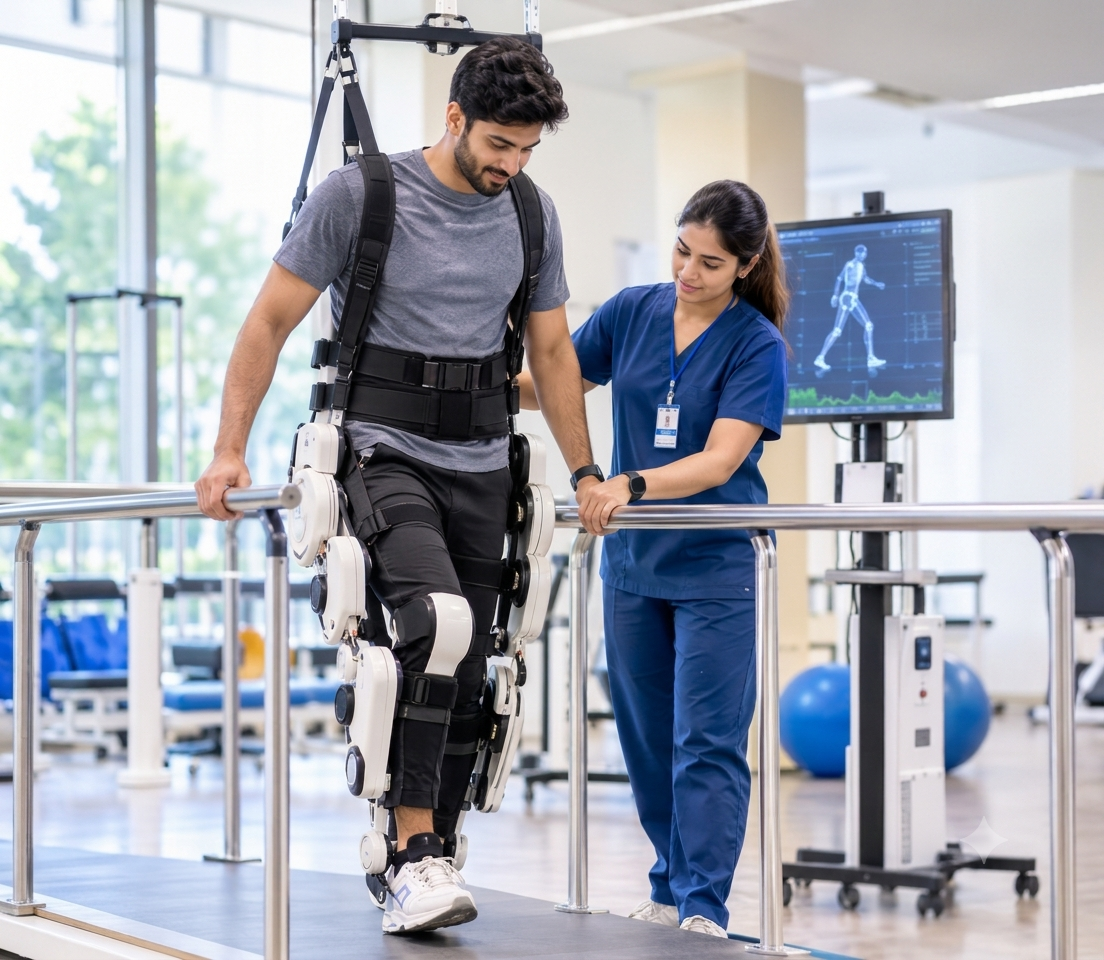
Robotic rehabilitation is not one machine. Different devices train different movements, and your therapist chooses the one that matches your goal.
| Your goal | What this type of device does | Often used after |
|---|---|---|
| Walking (gait training) | Supports body weight and guides the legs through a walking pattern | Stroke, spinal cord injury |
| Arm and hand | Guides shoulder, elbow, wrist and finger movements, often with on-screen games | Stroke, brain injury |
| Balance | Tracks how you shift your weight and trains steadiness | Stroke, nerve conditions, spine surgery |
| Posture and spine | Gives feedback on alignment during movement | Back and neck problems |
Not every goal needs a device. At your assessment, Dr. Raikwar will tell you which, if any, will help, and you will see the equipment before you begin.
Benefits of Robotic Physiotherapy
Repetitive, guided practice
selected movements can be repeated many times, with support adjusted to your ability.
Support during movement
a device can assist limb movements that are hard to perform independently.
Progress tracking
many systems record movement data, so your therapist can monitor performance and adjust the plan.
Focused therapist guidance
while the device repeats the movement, the physiotherapist watches your movement pattern, gives feedback and changes the session as needed.
Does Robotic Physiotherapy Actually Work? What the Research Says
Short answer
it helps some people in some situations, and it works best as an addition to regular therapy.
The strongest evidence is for walking after stroke. A Cochrane review published in May 2025, covering 101 trials and 4,224 adults, found that gait training devices combined with physiotherapy probably help more people walk independently by the end of treatment than physiotherapy or usual care alone. In round numbers, one extra person walked independently for every nine treated.
The same review also found that
- The benefit for independent walking may not last at later follow-up.
- Gains in walking speed were small on average.
- How often and how long to use the devices is still unclear.
Evidence for spinal cord injury, brain injury and arm robots is more limited than for stroke walking. That is why we do not promise miracle recovery. We use robotic therapy where it is most likely to help, measure your progress, and change course if it is not working. For a plain comparison, read our guide to robotic vs regular physiotherapy.
Robotic Therapy vs Traditional Physiotherapy
| Aspect | Robotic therapy | Traditional physiotherapy |
|---|---|---|
| Repetitions per session | Many, at consistent quality | Fewer, as therapist effort allows |
| Feedback | Live on screen, with recorded data | Therapist’s observation and touch |
| Judgment and adjustment | Set and supervised by your therapist | Therapist-led throughout |
| Hands-on techniques | Not available | Manual therapy, mobilisation, dry needling |
| Best for | Relearning movement patterns | Pain, stiffness, mobility, everyday function |
Most patients get a mix. Robotic sessions build movement patterns, and hands-on therapy handles pain, stiffness and muscle tightness. If your main problem is back pain, the better question may be whether you need physiotherapy or surgery. Read physiotherapy or surgery for back pain or visit our Back Pain Treatment in Indore page.
Neuro Physiotherapy in Indore: Meet Your Rehabilitation Team

Dr. Shivani Raikwar | Neuro and Spine Physiotherapist
Dr. Shivani Raikwar provides neuro and spine rehabilitation, including robotic-assisted rehabilitation where appropriate, along with hands-on physiotherapy. Her areas of training include dry needling, cupping therapy, spinal mobilisation and cancer rehabilitation. Treatment is planned around each patient’s condition, mobility and goals.

Dr. Sandeep Moolchandani | Neurosurgeon and Spine Surgeon
Start Your Recovery Plan
Recovery takes time, but the right plan, started early, makes a real difference. Whether you need rehabilitation after a stroke or after a spinal cord injury, book an assessment and find out whether robotic physiotherapy is right for you.

Your First Visit: What to Expect
Conversation
We ask about your condition, surgery or injury, medicines and what you want to get back to doing.
Assessment
A physical examination checks strength, movement, balance, walking, posture and nerve function.
Plan
You get clear goals, a realistic timeline and the mix of robotic and hands-on therapy that suits you.
Sessions
Each session is supervised, and progress is recorded so you can see what is changing.
Review
The plan is reviewed regularly. If a surgical opinion is needed, we say so early.
Is Robotic Therapy Right for You?
Often a good fit
- You are in the first months after a stroke and have trouble walking or using an arm
- You have weakness after a spinal cord or brain injury
- You need many repetitions to relearn a movement
- You are recovering from surgery and your surgeon has cleared you to start
May not be suitable, or may need to wait
- An unstable fracture or a surgical wound that has not healed
- Uncontrolled blood pressure or an unstable heart condition
- Skin wounds or pressure sores where the device would touch
- Severe stiffness or joint contracture that limits safe movement
- Difficulty following instructions or staying safely positioned
This list is general, and the final decision follows your assessment. Choose a treatment because your assessment says it fits, not because it is advertised as advanced technology.
Where to Find Us
Samarth Neuro Spine Centre G-02, Prime Arcade Building, Plot 428, Opposite CHL Hospital, near Dewas Naka, Scheme No. 114, Indore, Madhya Pradesh 452010
Frequently Asked Questions
It is rehabilitation that uses robotic devices to guide precise, repeated movements of the arm, leg or walking pattern, supervised by a physiotherapist. It is used for selected patients recovering from stroke, spinal cord injury, brain injury and surgery, alongside hands-on therapy.
The device supports your limb and repeats a movement the same way each time, while sensors record your effort. Your therapist sets the level of help and lowers it as you get stronger.
Not as a replacement. For stroke, robotic gait training added to physiotherapy helps more people walk independently by the end of treatment, but hands-on physiotherapy remains essential for pain, stiffness and everyday function.
It can help selected patients relearn movement, particularly walking and arm use, when combined with regular therapy. It cannot promise full recovery. Your assessment shows what is realistic for you.
It depends on your condition, how long ago it started and your goals. After your assessment, your therapist gives an expected range of sessions, and the cost is explained before you begin.
Yes, when used on suitable patients under supervision. Devices are adjusted to you and your therapist monitors throughout. Some conditions make it unsuitable, which is why an assessment comes first.
It may help selected patients with walking and strength after surgery, depending on the procedure and your surgeon's advice. Many people also recover well with standard guided physiotherapy.
The right choice depends on your condition. Look for an MPT in Neuro, experience with stroke and spinal conditions, named equipment, a clear assessment before treatment, and access to a neurosurgeon. At Samarth Neuro Spine Centre, Dr. Shivani Raikwar (MPT, Neuro) leads robotic and hands-on rehabilitation, with a neurosurgeon on the same team.
No, you can book directly. If your assessment shows you need a neurosurgical or neurological opinion, we will tell you.
Call +91-7000-11-5912 or book an appointment online. Tell us the condition and when it started, and we will arrange a physiotherapy assessment and tell you what to bring.