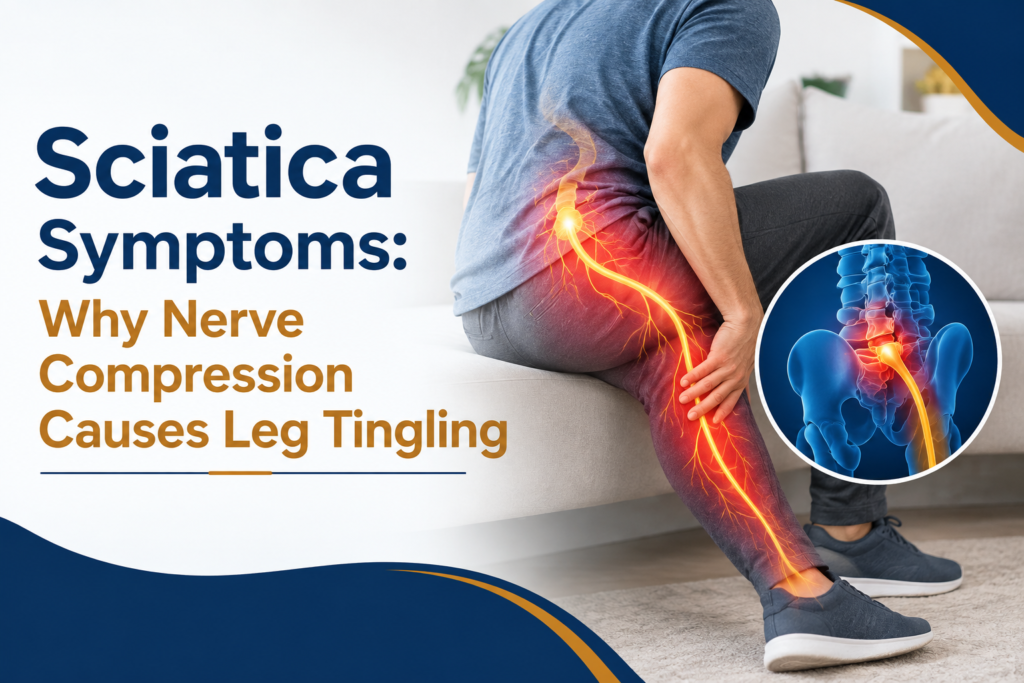
Tingling that travels from your lower back down to your leg usually means a nerve is being pinched somewhere along your spine, most commonly the sciatic nerve. This is called sciatica, and it happens when a disc, a bone spur, or spinal swelling presses on the nerve root before it branches down your leg. It is not something you have to just live with, and in most cases it does not need surgery.
If you sit for long hours at a desk, drive frequently, or recently lifted something heavy the wrong way, you already know how a dull ache in the lower back can slowly creep down into the leg. What starts as mild discomfort can turn into a constant pins-and-needles feeling, and that’s usually the point where people start searching for answers instead of waiting for it out.
What Nerve Compression Actually Feels Like
Sciatic nerve compression doesn’t always show up the same way in every person. Here’s what to watch for:
- A tingling or “electric” sensation running from the lower back through the buttock and down one leg
- Numbness in the foot or toes, especially after sitting for a while
- A dull ache that turns sharp when you cough, sneeze, or bend forward
- Weakness in the leg that makes it hard to stand on your toes or lift your foot
- Pain that gets worse with prolonged sitting and slightly better when you walk
If you’re noticing two or more of these together, it’s worth getting checked rather than waiting for it to pass on its own.
Why Does This Happen in the First Place
The spine is made up of vertebrae stacked with soft discs in between, and nerves run through small openings on either side. When a disc bulges, when the space around a nerve narrows, or when muscles around the spine go into spasm, the nerve gets squeezed. That compression is what sends the tingling signal down the leg, since the nerve fibers that carry sensation are being disturbed at the source.
Sciatica specialist doctor in indore consultations usually start with exactly this kind of history-taking, when the tingling started, what makes it worse, and whether it’s on one side or both, because those details point toward the actual cause before any scan is even ordered.
Do You Need Surgery, or Can This Be Managed Without It
This is the question most people actually want answered, and the honest answer is that most sciatica cases improve without surgery. A structured, non-surgical approach usually comes first:
- Activity modification – not full bed rest, but avoiding the specific movements that aggravate the nerve
- Physiotherapy – targeted exercises that take pressure off the compressed nerve and strengthen the muscles supporting your spine
- Medication – anti-inflammatory medication for a short course to bring down nerve irritation
- Targeted injections – in select cases, an injection near the affected nerve root to reduce swelling directly at the source
Non-Surgical Sciatica Treatment in Indore works for the majority of patients when it’s started early, before the nerve compression becomes severe or prolonged enough to cause lasting weakness. Surgery is reserved for cases where non-surgical treatment fails over several weeks, or where there’s significant weakness or loss of bladder or bowel control, which is considered a genuine emergency.
When You Should Stop Waiting and Get Checked
A few situations mean you shouldn’t wait for a routine appointment:
- Numbness or weakness that’s getting worse over days, not better
- Loss of bladder or bowel control alongside leg symptoms
- Pain severe enough that you can’t stand, walk, or sleep
- Symptoms in both legs at the same time
Outside of those red flags, if tingling or discomfort has lasted more than one to two weeks, that’s a reasonable point to get a proper evaluation rather than self-managing indefinitely. It’s also worth knowing that nerve irritation from a spine problem can sometimes lead to lasting nerve damage if it’s left unaddressed for too long, which is covered in more depth in Can a Herniated Disc Cause Permanent Nerve Damage?, a closer look at what happens when nerve compression goes untreated.
Sciatica Treatment in Indore at Samarth Neuro Spine Centre starts with a clinical exam and, where needed, imaging to confirm exactly which nerve is affected and why, so the treatment plan matches the actual cause instead of just masking the pain.
Getting evaluated by a neurosurgeon rather than jumping straight to a scan also means someone is looking at the whole nerve pathway, not just what shows up on the disc image. Dr. Sandeep Moolchandani, recognized as one of the Best Neurosurgeon in Indore for spine-related nerve conditions, brings that broader view to every sciatica case that comes in.
Frequently Asked Questions
1. Does sciatica go away on its own?
Often, yes. Time, rest from aggravating movements, and gentle activity resolve many mild cases within a few weeks. Persistent or worsening symptoms need evaluation rather than more waiting.
2. Which leg does sciatica usually affect?
Almost always one side. Pain or tingling in both legs at once is less typical of ordinary sciatica and is one of the signs that warrants prompt evaluation.
3. Is walking good or bad for sciatica?
Generally good, in moderation. Gentle walking keeps the area mobile, while prolonged sitting tends to make the pressure and pain worse.
4. Can sciatica cause permanent damage if untreated?
In prolonged or severe nerve compression, yes, lasting numbness or weakness is possible. This is why persistent symptoms shouldn’t be ignored indefinitely.
5. Is tingling in the leg always sciatica?
Not always. It can also come from diabetes-related nerve issues, poor circulation, or sitting in one position too long. A proper exam tells these apart.
6. When should I see a sciatica specialist doctor in Indore instead of waiting?
If tingling, numbness, or weakness lasts more than one to two weeks, or you notice any red-flag symptoms like bladder changes.
Ready to Get This Checked Properly?
If tingling has been traveling from your back to your leg for more than a week or two, it’s worth finding out exactly what’s causing it. Call Samarth Neuro Spine Centre at +91-7000-11-5912 to book a consultation and get a clear, honest assessment of what’s going on.