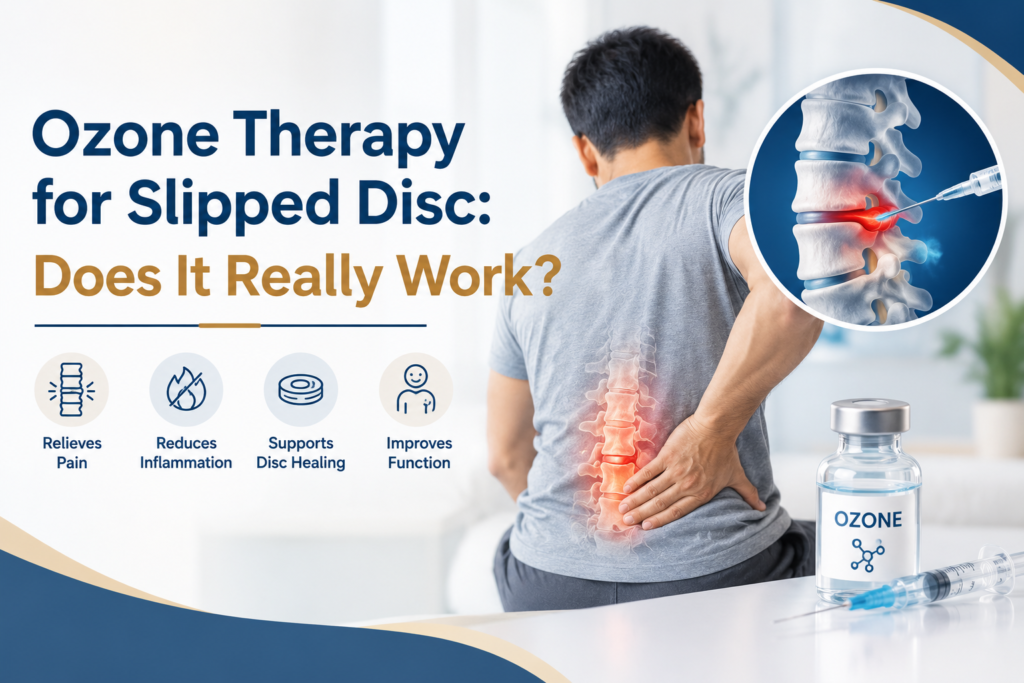
Ozone therapy for a slipped disc involves injecting a small amount of ozone-oxygen gas near the affected disc to reduce inflammation and ease pressure on the nerve. It’s a non-surgical option that some patients try before considering surgery, and for the right candidate, it can genuinely reduce pain. It is not, however, a fix for every slipped disc, and knowing who it actually helps matters more than the procedure itself.
A slipped disc, also called a herniated or prolapsed disc, happens when the soft inner layer of a spinal disc pushes through a weakened outer layer and presses on a nearby nerve. That pressure is what causes the pain, tingling, or numbness that radiates into the back, leg, or arm. Most people want to avoid surgery if there’s a reasonable non-surgical path, which is exactly where ozone therapy fits into the conversation.
How Ozone Therapy Actually Works
Ozone gas, when injected in small controlled amounts near the disc, is believed to work in a few specific ways:
- Reduces inflammation around the compressed nerve, which is often the main source of pain
- Shrinks the disc material slightly, easing direct pressure on the nerve root
- Improves local oxygen delivery, which may support the body’s own healing response
The procedure itself is done under local anesthesia, takes a short amount of time, and most patients go home the same day without needing an overnight stay.
Who Is a Realistic Candidate
This is the part that matters most, and it’s where a lot of general articles about ozone therapy fall short. Slip Disc Treatment in Indore using ozone therapy tends to work best for patients who:
- Have disc-related pain without significant nerve weakness
- Haven’t responded fully to rest, medication, and physiotherapy alone
- Want to avoid or delay surgery and understand it’s not guaranteed to eliminate the problem
- Don’t have a large disc fragment that’s severely compressing the nerve
Patients with significant nerve weakness, loss of bladder or bowel control, or a large disc herniation usually aren’t good candidates, since those situations often need more direct intervention.
What the Evidence Actually Shows
Ozone therapy has been studied for disc-related pain, and the research so far is genuinely promising for symptom relief and improved function in properly selected patients, though it’s still considered an evolving treatment rather than a universally standardized one. That distinction matters. Herniated Disc Treatment in Indore decisions should be based on an honest read of what a treatment can and can’t do, not on the assumption that any non-surgical option is automatically risk-free or guaranteed to work.
Possible Side Effects and Limitations
Like any medical procedure, ozone therapy carries some considerations worth knowing upfront:
- Mild local irritation or soreness at the injection site
- Rare allergic reactions to the ozone-oxygen mixture
- Results that vary by patient, some get significant relief, others get partial or short-term relief
- It’s not a substitute for surgery in cases with true structural nerve compression that needs decompression
Ozone Therapy vs Other Non-Surgical Options
Ozone therapy isn’t the only non-surgical route for a slipped disc. Steroid injections, physiotherapy, and activity modification are also used, often in combination rather than alone. If you’re weighing your non-surgical options more broadly, What Are the Various Annular Tear Treatment Options? walks through injection-based and conservative approaches side by side, which is useful if ozone therapy alone isn’t the right fit for your specific case.
A Slip Disc Specialist in Indore will usually walk you through all the non-surgical options together during your first visit, rather than jumping straight to one treatment, so you understand the full picture before deciding.
Frequently Asked Questions
1. How successful is ozone therapy for a slipped disc?
Published clinical studies report success in roughly 70 to 80% of properly selected patients, defined as meaningful pain relief and improved function.
2. Is ozone therapy painful?
Most patients describe mild discomfort at the injection site, similar to a regular injection, since it’s done under local anesthesia.
3. How many sessions are usually needed?
This varies. Some patients improve after one session, others need a short series spaced weeks apart, confirmed after your evaluation.
4. Is the result from ozone therapy permanent?
When it works, the disc-shrinking effect is generally lasting, though long-term outcomes still depend on the individual case and lifestyle factors.
5. Can ozone therapy be used after a failed surgery?
Yes, it’s sometimes used in patients who’ve had surgery and continue to have symptoms, though candidacy is decided case by case.
6. Is ozone therapy safe?
When performed by a trained specialist with proper technique, it’s considered low-risk, though like any injection it carries a small risk of irritation or reaction.
Find Out If You’re a Candidate
Not every slipped disc needs surgery, but not every slipped disc is right for ozone therapy either. Call Samarth Neuro Spine Centre at +91-7000-11-5912 for an honest evaluation of which non-surgical options actually fit your case.advancing our understanding of ozone therapy and its role in managing spinal conditions like slipped discs.