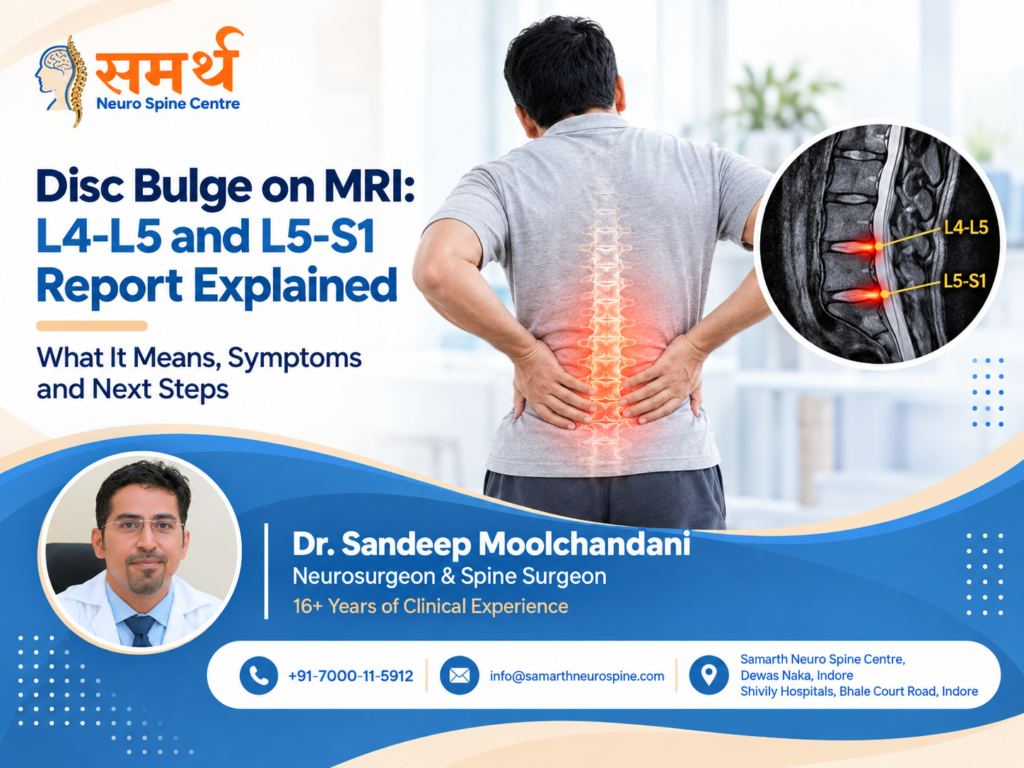
A disc bulge on MRI means a spinal disc has pushed slightly past its normal edge. It is a very common finding and does not automatically mean you need surgery. What matters is whether the bulge is pressing on a nerve and whether that fits your symptoms, such as back pain, leg pain, numbness or weakness.
If your report says “broad-based posterior bulge”, “annular fissure” or “thecal sac indentation”, it is easy to fear the worst. This guide explains the common L4-L5 and L5-S1 findings in plain language, so you know which lines deserve attention and which can wait.
Why a Bulge on Your Scan Is Not Always a Problem
Here is the fact that surprises most patients. A 2015 review of scans from people with no back pain found disc bulges in about 30% of 20-year-olds and about 84% of 80-year-olds. A bulge is often just part of ageing, like grey hair.
That is why a report should never be read on its own. A scan shows structure. It cannot tell you which finding is causing your pain. A small bulge that touches no nerve may need no specific treatment, while one that squeezes a nerve and matches your leg symptoms deserves a closer look.
What L4-L5 and L5-S1 Mean
Your lower spine has five bones, L1 to L5, sitting above the sacrum (S1). The L4-L5 and L5-S1 discs are the lowest two. They carry the most load and move the most, so changes show up there first.
L4-L5 bulge: It can irritate the L5 nerve. Pain may run down the outer leg to the top of the foot or big toe, sometimes with tingling or trouble lifting the front of the foot.
L5-S1 bulge: It can affect the S1 nerve. Pain may run down the back of the leg to the outer foot, sometimes with numbness or weakness when pushing up onto the toes.
These patterns guide the examination, but they do not prove which nerve is involved. Symptoms vary, and many bulges at these levels cause no nerve trouble at all.
If your pain travels from the back into the leg, a Sciatica Doctor in Indore can check whether nerve irritation is the cause.
MRI Report Words, Translated
| Report term | What it means |
| Disc desiccation | The disc has lost water, often with age |
| Disc degeneration | Wear and tear in the disc over time |
| Disc bulge | The disc extends evenly beyond its edge |
| Protrusion | A more focused push outward |
| Extrusion | Disc material has broken through the outer wall |
| Sequestration | A piece of disc has separated from the main disc |
| Annular fissure | A crack in the disc’s outer ring |
| Thecal sac indentation | The disc touches the sac around the nerves |
| Nerve root compression | A nerve is being pressed or crowded |
| Foraminal narrowing | The exit gap for a nerve has narrowed |
| Spinal canal stenosis | The main canal holding the nerves has narrowed |
No term should be judged by its name alone. What counts is the location, the severity and whether it matches your examination. If your report mentions a crack in the disc, read our guide to annular tear treatment options.

The Findings That Deserve Closer Attention
These lines matter most when they match your symptoms:
- Nerve root compression on the same side as your leg pain
- An extrusion or separated fragment with nerve symptoms
- Significant narrowing of the canal or nerve exits
- Anything that could explain growing numbness, weakness or trouble walking
A mild bulge or dried-out disc with no nerve contact often explains nothing. The key is to read the MRI together with a hands-on examination, not to act on one scary phrase.
Holding an MRI report you cannot make sense of? Get a clear answer, not a guess.
Does Your Bulge Match Your Symptoms?
Ask yourself these questions before you panic:
- Where does the pain travel? Back only, or into the buttock, calf or foot?
- Is there tingling or numbness?
- Is there weakness? Is lifting the foot or standing on your toes getting harder?
- Is it on the same side as the scan finding? A right-sided bulge cannot explain left-sided leg pain.
- What does the examination show? Strength, reflexes, sensation and walking all help.
When the answers do not line up, the bulge may be a bystander and the real cause lies elsewhere. A Back Pain Specialist in Indore will test these things before deciding what your scan means.
How Bulged and Herniated Discs Are Treated
The good news is that most people improve without surgery. Herniated Disc Treatment in Indore usually begins with a few steps:
- Activity changes: avoiding movements that flare the pain, while staying active
- Physiotherapy: a tailored plan for strength, posture and safe movement
- Medication: pain relief or anti-inflammatory medicine, chosen for your health history
- Injection: an epidural steroid injection for strong leg pain that is not settling
Long bed rest slows recovery, so gentle walking is usually encouraged. Symptoms can improve even when the MRI still shows the same disc changes.
When Surgery Is Considered
Surgery is for specific situations, not for every bulge on a report. Doctors consider it when:
- Weakness or foot drop is present or getting worse
- Disabling leg pain continues despite a fair trial of non-surgical care
- MRI shows nerve compression that matches your symptoms and examination
Seek emergency care at once if you develop loss of bladder or bowel control, numbness around the groin or inner thighs, or rapidly worsening leg weakness. These can signal severe nerve compression and cannot wait for a routine appointment.
When surgery is right, the aim is to remove only the part of the disc pressing on the nerve. Our page on disc prolapse surgery explains the options.
What to Bring to Your Consultation
At Samarth Neuro Spine Centre, we relate your scan to your symptoms and examination before any treatment is discussed. To make the visit count, bring:
- The actual MRI images (disc or digital access), not just the report
- Older scans, if you have them
- A short note on when symptoms began and whether they are improving or worsening
- Details of treatment you have already tried
Take it all to a Spine Specialist in Indore who looks at the images and examines you first.
Frequently Asked Questions
1. Is a disc bulge at L4-L5 serious?
Usually not. It is one of the most common findings on lumbar MRI. It becomes a concern only when it presses on a nerve and causes leg pain, numbness or weakness.
2. Can a disc bulge heal on its own?
Many improve with time. The pain often settles within weeks to a few months, and larger herniated discs can shrink as the body reabsorbs them. The bulge may still show on a repeat scan even after your symptoms are gone.
3. What is the difference between a bulge and a herniated disc?
A bulge is a broad, even push of the disc beyond its edge. A herniation is more focused, and disc material breaks through the outer wall. Herniations are more likely to irritate nerves.
4. Do I need surgery for an L5-S1 disc bulge?
Most people do not. Surgery is considered for worsening weakness, bladder or bowel changes, or severe leg pain that does not improve after a proper trial of non-surgical care.
5. Can I walk and exercise with a disc bulge?
Gentle walking is usually helpful. Avoid heavy lifting and repeated forward bending while the pain is active, and ask your doctor or physiotherapist which exercises suit you.
6. Why does my MRI look bad but I have no pain?
Because many pain-free people have bulges and age-related changes. Scan findings only matter when they match your symptoms and examination.
Final Word
A disc bulge on your MRI is a finding, not a complete diagnosis. The real questions are whether a nerve is affected, whether that explains your symptoms, and whether treatment is needed.
If you have been typing Back Pain Doctor Near me into your phone while staring at a worrying report, get the scan read alongside a proper examination before you decide anything.
| Ready to know what your MRI really means? Book Your Consultation at Samarth Neuro Spine Centre or call +91-7000-11-5912 to speak with our team. |